About Dutch FC
He grew up playing football in the Netherlands, at a club that sat in the middle of its neighborhood. Dues were low. Everyone got on the field. And the game itself was taught, not just organized. When his own kids were old enough to play in Texas, he went looking for that. He found something else.

Wilco Ravestijn — Dutch FC founder
He found a market with good coaches and good intentions arranged around the wrong priorities. Every club promised the same three things Dutch clubs deliver — enjoyment, development, competition. The words were identical. The order wasn't.
In the Netherlands the sequence is not negotiable: kids fall in love with the game, they're taught to play it intelligently, and then they compete hard. In North Texas the sequence gets inverted — competition sold first, development promised last. No Dutch club would survive that inversion, because a club that doesn't develop players has nothing to compete with.
So in 2018 he started Dutch FC with four recreational players and one rule: get the order right, and let everything else follow.
Transparent, merit-based pay
You know exactly what you'll earn, and if you grow your team, your pay grows with it. Your success is in your hands — not up to someone else's discretion.
Transparent, merit-based pay
You know exactly what you'll earn, and if you grow your team, your pay grows with it. Your success is in your hands — not up to someone else's discretion.
"Every club in this market promises the same three things. The difference is which one they put first."
The three priorities, in detail →
— The Problem
Two things are holding American soccer back. Neither is talent.
There is no shortage of athletic ability in North Texas. What's in short supply is affordability and access — and both are products of how the system is built, not of how hard anyone is working inside it.
Problem one: the cost of entry.
America's pay-to-play model has been criticized for years, and the criticism is fair. Competitive youth soccer here regularly runs into the thousands per season before a family has booked a single hotel room.
Here's the honest version of our own position: compared to a Dutch club, Dutch FC is expensive. Most youth clubs in the Netherlands are supported in part by their municipality. We aren't. Nobody is writing us a check.
What we could control was structure. The large majority of Dutch clubs are community-based organizations run like non-profits. In North Texas the ratio runs the other way — most clubs operate for profit, which means growth and profit isn't just a strategy, it's a requirement. Non-profit isn't a tax status here. It's the answer to "where does my money go?" — coaches, fields, lights, players. There's no owner taking a cut.
See exactly what we charge and what it includes →
Problem two: the door only opens for big clubs.
This is the problem most parents feel but can't name. The premier travel platforms in this country admit clubs, not teams — and club-level membership rewards size. So the incentive isn't to develop better players; it's to get bigger. Clubs merge. Clubs absorb. Clubs consolidate until they clear the bar. And having cleared it, they market the platform hard, because the platform is what justifies the fee.
The Netherlands works the other way. League competition is decentralized, and promotion and relegation reach all the way down to the smallest clubs. A club of 200 players can earn a high division if its team is good enough that season. Small clubs don't just survive there, they thrive. And small clubs give kids what scale structurally can't: more access, more attention from a coach who knows their name, more opportunity.
Transparent, merit-based pay
You know exactly what you'll earn, and if you grow your team, your pay grows with it. Your success is in your hands — not up to someone else's discretion.
Transparent, merit-based pay
You know exactly what you'll earn, and if you grow your team, your pay grows with it. Your success is in your hands — not up to someone else's discretion.
"If your child is on the 11th team in an age group, they are not getting what the 1st, 2nd or 3rd team is getting. Same crest. Different club."
And the obvious question back at us: we field 50+ teams ourselves. So here's our answer — at Dutch FC the difference between a top squad and a fourth squad is the level of competition, not the level of investment. Same curriculum, same training hours, same coaching standard, same building. That's the deal, and you can hold us to it.
—
What We Do Instead
Development happens in training, not in the league you play in.
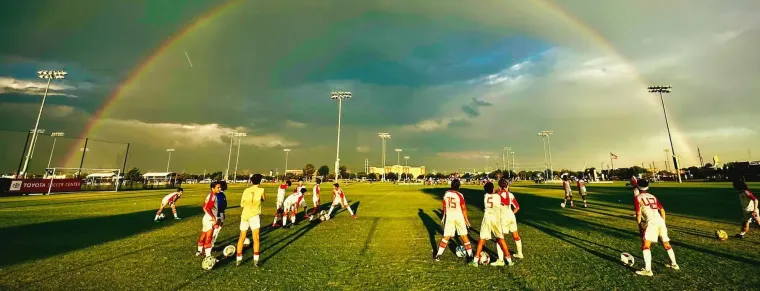
Watch one match and count the touches. A player is on the ball for only a few minutes of the entire game. In one training session, the touches and the decisions run into the hundreds.
We think development is roughly 80% training, 20% league play. The league your child is placed in does not develop them. The two hundred sessions do. So we invest where the reps are — more training, better coaching, competition close to home — rather than paying a premium for a badge and then spending the season in a car.
To be clear about our own leagues: we compete in N1, ECNL Regional League North Texas, Classic League and others, and we're proud of it. Our teams earned in. The badge is a result of development, not a substitute for it.
There's a squad for every player. Every player who earns a place at Dutch FC gets a real one — real coaching, real training, real competitive games at a level that actually stretches them. We don't stack a top team and warehouse everyone else. Access isn't a slogan here. It's a roster structure.
How the Squad System works →
The competition that matters is closer than you think. By 17 or 18, a technically proficient player with a real soccer brain can step into our UPSL first team and compete with and against former college and professional players — a harder, faster, more instructive environment than most youth travel leagues, and it's local. Since we completed the pyramid in 2026, a player can start at Dutch FC at U6 and play adult semi-pro football without ever leaving the club.
A real connection to the Netherlands.
We're not going to claim a Dutch pipeline we haven't finished building. We're working on relationships with KNVB-licensed staff and Dutch academy coaches, with the goal of player exchange programs and a genuine route to professional football for players good enough to take it. Named coaches, named academies — we'll publish them the day they're signed.
Transparent, merit-based pay
You know exactly what you'll earn, and if you grow your team, your pay grows with it. Your success is in your hands — not up to someone else's discretion.
Transparent, merit-based pay
You know exactly what you'll earn, and if you grow your team, your pay grows with it. Your success is in your hands — not up to someone else's discretion.
—
The Timeline
Eight years, four players to a complete club.
2018 – 2019
The four
Dutch FC starts with four recreational players. Within a year: two select teams and two academy teams.
2020 – 2021
Room to grow
Past 200 players, then 300. Expansion to five fields and the first major facility improvements.
2022 – 2023
Lights on, level up
Lighting installed across four fields. Past 350, then 400 players. Teams move from developmental to intermediate play.
2024 – 2025
Built to compete
Directors hired to push advanced-level play. College Placement Program launches. Squad System goes club-wide. Founding 2008 team graduates to college soccer.
2026
Pyramid complete
Dutch FC enters N1 and ECNL Regional League North Texas, adds a UPSL first team. U6 to semi-pro, one club.
— Where We Are Now
Coach-run, non-profit, and still building.
Everything above was decided by coaches. Not a board, not an ownership group — the people running training sessions are the people setting the direction. That's why the curriculum is the same at the top squad and the fourth squad, why the lights got installed before anything cosmetic, and why the first team exists at all. It also means we're not finished. Ask us in two years and the numbers will be different.
Est. 2018
Founded
5
Fields, 4 lit
U6 → Semi-pro
Complete pathway
1
Home — Frisco
Meet the staff →
— The Part That Isn't About Soccer
We're raising people, not just players.
Most of our players will not play professionally. All of them will be adults. We coach character on purpose, on the schedule, with the same seriousness as first touch — through our Game Plan for Life programming and our partnership with the Fellowship of Christian Athletes. And in 2025 we helped launch the Stonebriar Community Sports Soccer League, so kids in this community have a fun, low-barrier way into the game whether or not they ever play club soccer.
Families of every background are welcome here. We just think you should know what we care about before you sign up.
The Whole Argument
You're going to pay for youth soccer either way.
The question is what you're paying for: a league badge and a travel schedule, or coaching, training hours and a club where your kid actually plays.
One of those buys a season. The other builds a footballer.
PHASE 1 = DRIBBLING
PHASE 2 = PASSING
PHASE 3 = SHOOTING & FINISHING
SESSION 1 = Dribbling for Control
On The Ball Manipulation, Coordination, Agility on the Ball and Being comfortable with the Ball
SESSION 2 = Dribbling for Speed
Ball Maneuvering in Tight Spaces
SESSION 3 = Dribbling for Possession
Turning and Change of Direction
SESSION 4 = Dribbling for Penetration
Beating Opponents
DRIBBLING
SESSION 5 = Short-Range Passing & 1st Touch
Within 10 Yards
SESSION 6 = Mid-Range Passing & 1st Touch
10 - 20 Yards
SESSION 7 = Passing for Possession
Back-Foot Taking Space
SESSION 8 = Advanced Passing for Possession
Increasing Speed of Execution
SESSION 9 = Shooting Fundamentals
Proper placement of non-kick and kicking foot
SESSION 10 = Shooting & Finishing Fundamentals
Body, Angle & Ball placement
SESSION 11 = Finishing off of Crosses
Timing, Technique choices & angles
SESSION 12 = Advanced Shooting & Finishing
Situational Awareness and Adaptability