
Understanding the Structure of Club Soccer
To find local club soccer teams, start by searching state soccer association directories, filtering organizations by competitive level (recreational, select, or academy), and registering for seasonal tryouts hosted in late spring and early winter. Evaluating coaching credentials, facility safety standards, and team roster sizes will ensure you choose the ideal developmental pathway for your child.
Navigating youth soccer can feel overwhelming at first. Between national sanctioning bodies, regional leagues, and independent clubs, the structure requires a quick map. At the top of the pyramid sits the U.S. Soccer Federation, which sanctions governing bodies like US Youth Soccer(USYS). State associations operate under these sanctioning bodies to manage leagues, govern player registration, enforce safety protocols, and maintain sanctioned tournament circuits.
When families step into this world, the primary decision usually comes down to recreational vs competitive club soccer. Recreational soccer emphasizes basic participation and equal minutes, often led by volunteer parents. In contrast, competitive club soccer organizations focus on long-term athletic mastery, structured tactical education, and licensed coaching. Understanding these distinctions early helps families set realistic expectations about time commitment, travel, and cost before committing to a season-long program.
| Level | Primary Focus | Coaching Type | Time Commitment | Travel Expectations |
|---|---|---|---|---|
| Recreational | Introduction to soccer, fun, social play | Volunteer parents / community staff | 1–2 sessions per week | Local community parks only |
| Competitive Select | Technical mastery, tactical awareness, structured competition | Nationally licensed professional coaches | 2–3 practices per week + weekend games | Regional league travel & local tournaments |
| Academy / Pre-Pro | High-performance development, collegiate & pro pathways | Elite licensed staff & technical directors | 3–4 practices per week + video analysis & conditioning | Regional/national showcase travel |
Key Levels within Competitive Club Soccer
Within competitive organizations, teams are placed into distinct tiers to ensure players compete against peers with similar skill and drive. Grassroots tiers introduce younger athletes (typically U7 to U10) to foundational ball mastery, basic spacing, and small-sided games. These small-sided environments maximize touches on the ball and encourage rapid decision-making in tight spaces.
As players grow into the U11 through U14 brackets, they transition toward full-sided matches and premier developmental leagues where spatial awareness, passing tempo, and team tactics become central to their growth.
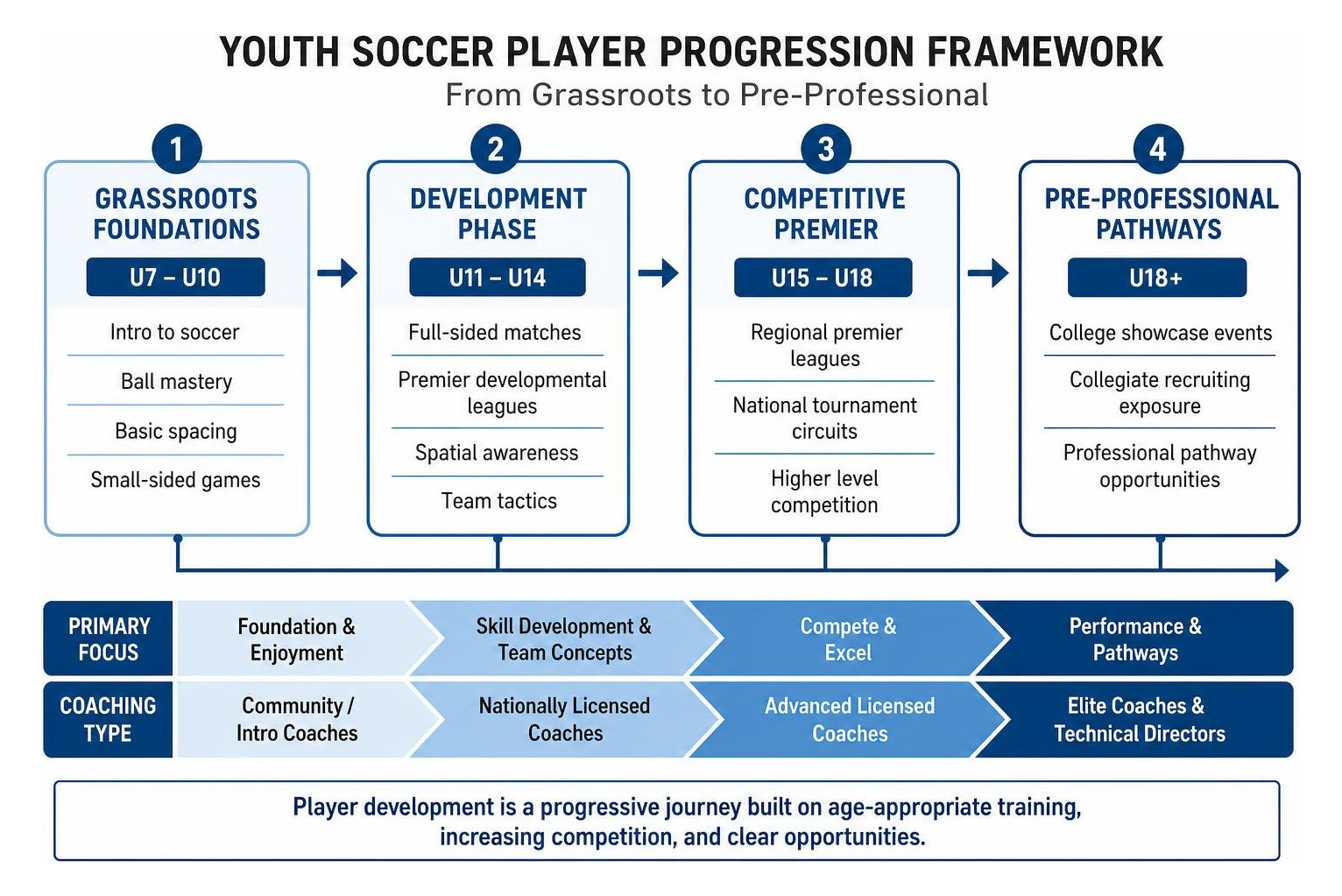
For families searching for dedicated local youth soccer academy programs, these structured tiers provide clear milestones. High-performing high school age groups move into regional premier leagues, national tournament circuits, and college showcase events designed to maximize collegiate scouting exposure and competitive maturity. Each transition point represents an opportunity for parents to reassess whether a club's coaching philosophy and travel schedule still align with their athlete's goals.
Affiliation Ecosystems and Player Opportunities
Well-established clubs build strong affiliations to unlock broader opportunities for their rosters. Many grassroots and community soccer models demonstrate how organized community clubs build strong local foundations through volunteer leadership, clear registration systems, and partnerships with local parks and recreation departments.
Top-tier programs often establish professional affiliate relationships, grant partnerships, and direct links to state-level talent identification like the Olympic Development Program (ODP). Affiliations also help clubs integrate specialized initiatives such as referee development networks and TOPSoccer—a community-based training program tailored for young athletes with intellectual, emotional, or physical disabilities. These comprehensive ecosystems ensure that every player, regardless of their starting point, has a structured environment in which to thrive, and they often give families confidence that a club is investing in the broader soccer community rather than operating in isolation.
How to Locate Local Youth Soccer Clubs and Academies
Finding the right organization starts with official sanctioning databases and regional directories. State association club finders allow parents to filter local clubs by zip code, play type (recreational, competitive select, or premier academy), and age groups. Using sanctioned directory tools ensures that the club you choose is fully vetted, insured, and compliant with national background checks, SafeSport requirements, and coaching education standards.
Beyond online research, inspect the quality of the training facilities where your child will spend their season. High-standard clubs operate out of multi-field athletic complexes featuring modern, well-drained artificial turf and quality natural grass surfaces. Training on quality surfaces reduces injury risks, promotes joint health, and allows young players to develop precise passing and control without being hindered by uneven ground or bad weather cancellations. Families touring a facility should also ask about locker room access, lighting for evening practices, and parking availability, since these details affect the overall weekly experience for both players and parents.
Evaluating Club Soccer Coaching and Philosophy
A club's facilities matter, but coaching leadership shapes the day-to-day experience. Look for clubs where coaches hold recognized licenses through national governing bodies and follow a unified technical curriculum. We believe that youth development should always prioritize individual technical confidence and game intelligence over short-term scorelines.
A healthy club development philosophy views every match as a classroom rather than a must-win championship. Too many youth programs fall into the trap of direct, kick-and-run tactics just to secure a weekend trophy at the expense of player growth. Understanding the balance between results and performance allows coaches to teach creative problem-solving. Rooted in Dutch Total Football principles, our approach emphasizes positional fluidity, spatial awareness, and composure under pressure so players learn to read the entire game rather than just memorize a single position. Over time, this style of coaching builds athletes who can adapt to multiple formations and roles, a skill set that becomes increasingly valuable as competition intensifies in older age groups.
Crucial Factors When Choosing a Soccer Club

Before signing a player registration contract, evaluate how the club manages its roster depth. Oversized rosters often leave developing players sitting on the bench during critical developmental years. Transparent organizations employ a structured squad system that establishes clear developmental rosters and ensures meaningful game minutes across the entire squad.
Earning fair playing time in youth soccer is essential for building confidence; training drills alone cannot replace real-time match decisions under competitive pressure. Finally, request a clear breakdown of transparent club fees and costs. A dependable club clearly outlines coaching fees, field rentals, league registrations, referee allocations, uniform packages, and expected tournament travel expenses upfront, avoiding surprise charges mid-season.
Long-Term Pathways: College Placement and Beyond
For high school athletes aspiring to play beyond youth leagues, a club's older age-group infrastructure becomes paramount. Top clubs support their players through structured showcase attendance, highlight video creation, and active networking with collegiate coaches across all division levels.
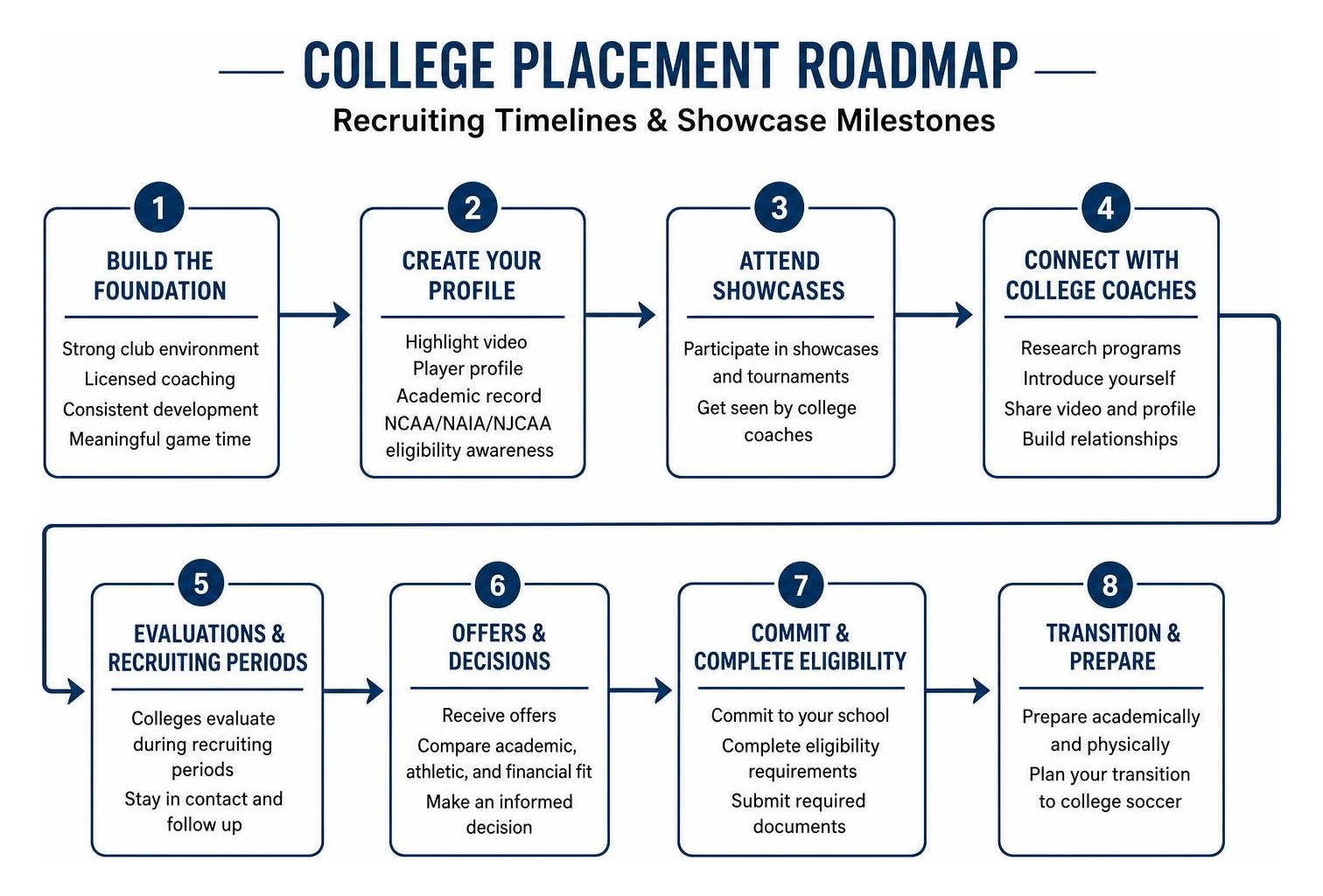
Through our dedicated college placement support, student-athletes receive direct guidance on NCAA, NAIA, and NJCAA recruitment rules and academic eligibility. Furthermore, pathways that bridge youth academies with pre-professional adult circuits—such as the United Premier Soccer League (UPSL)—offer elite teenagers an environment where they can test their skills against mature, physically demanding competition before heading to college or the professional ranks.
Preparing for the Selection Process and Tryouts
Most competitive clubs host primary tryouts in late spring and early summer for the upcoming seasonal year, with supplemental assessments during the winter break. Preparing early helps minimize the stress often associated with evaluation days.

To get the most out of competitive club tryouts, keep these preparation steps in mind:
- Register Online Early: Complete all player waivers and club profile forms ahead of time to ensure coaches have your player's accurate details and contact information.
- Focus on the Controllables: Remind your athlete that evaluators look closely at work rate, body language, coachability, and defensive recovery after a turnover.
- Arrive Prepared: Bring a properly inflated ball, plenty of water, shin guards, and proper footwear for both turf and natural grass surfaces.
- Play with Freedom: Coaches value composure, spatial awareness, and quick decision-making under pressure over flashy, individualistic play.
Frequently Asked Questions about Club Soccer
What is the difference between recreational and club soccer?
Recreational soccer is community-based, focusing primarily on fun, low commitment, and equal playing time with volunteer coaches. Club soccer is a performance-driven development model featuring professionally licensed coaching, structured technical curriculums, multi-day weekly practices, and regional league and tournament travel.
How much does joining a competitive youth soccer club typically cost?
Competitive club costs vary based on age group, league tier, and travel schedules. Total annual investments generally include registration dues, coaching fees, facility rentals, uniform packages, and travel expenses for out-of-town tournaments. Reliable clubs provide itemized fee sheets before tryouts so families can plan accordingly.
How do official club finder tools help parents choose a team?
State association and regional club finder tools allow parents to filter vetted, fully sanctioned youth soccer organizations by location, age group, and competitive tier. These tools ensure that your child registers with a program that adheres to national safety guidelines, insurance coverage, and coaching certification standards.
Conclusion
Choosing the right club environment shapes a child's love for the game and their athletic trajectory for years to come. By prioritizing long-term technical growth, transparent communication, and an empowering club culture over quick trophies, families can find a soccer home where their player genuinely thrives.
At Dutch Football Club, we remain dedicated to accessible, high-value player development through our authentic Total Football philosophy. Explore our competitive club soccer teams to find the right development pathway for your athlete.