
Why So Many Parents Are Confused by Youth Soccer Levels Explained
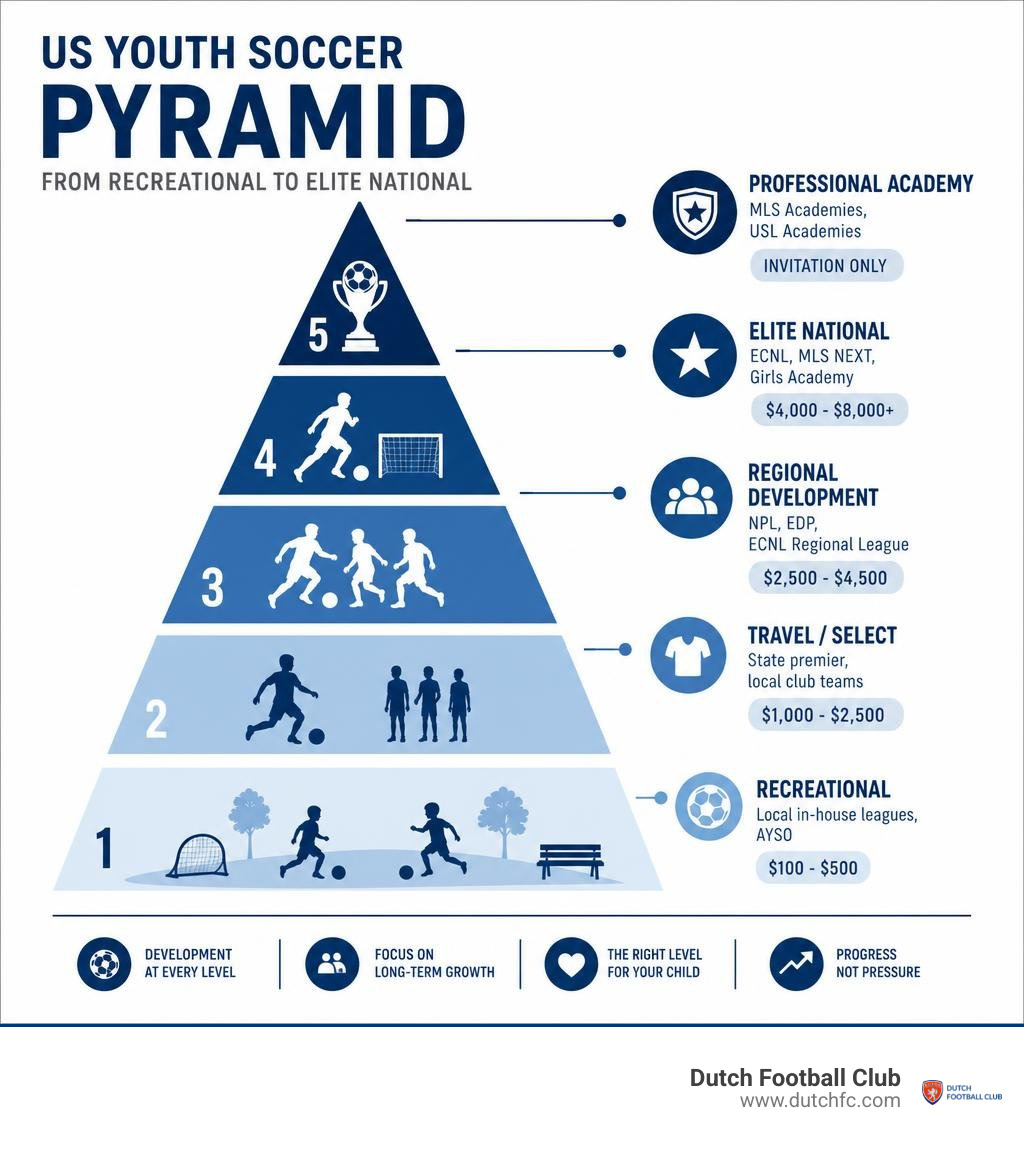
Youth soccer levels explained simply: the U.S. has no single national league. Instead, it runs a layered pyramid from local recreational play all the way up to elite national platforms. Here is the quick version:
| Level | Examples | Typical Annual Cost |
|---|---|---|
| Recreational | Local in-house leagues, AYSO | $100 - $500 |
| Travel / Select | State premier, local club teams | $1,000 - $2,500 |
| Regional Development | NPL, EDP, ECNL Regional League | $2,500 - $4,500 |
| Elite National | ECNL, MLS NEXT, Girls Academy | $4,000 - $8,000+ |
| Professional Academy | MLS Academies, USL Academies | $0 (invitation only) |
That table is the short answer. But the real question most parents are wrestling with is: which level is actually right for my child, right now?
And that is where it gets complicated.
There are two major governing bodies — US Youth Soccer (USYS) and US Club Soccer — each running their own league structures. Leagues overlap. Names like "Premier," "Gold," "NPL," and "ECNL" mean different things in different states. And starting in the 2026/2027 season, even the age groups themselves are changing.
It is a lot. And the stakes feel high when your kid loves the game and you want to make the right call.
I'm Wilco Ravestijn, spokesperson for Dutch Football Club in Frisco, Texas, and with over 25 years of experience in youth soccer development using the Dutch Total Football model, I've helped countless local families cut through the noise of youth soccer levels explained to find the right fit for their player. Let's break it all down clearly.
The US Youth Soccer Pyramid: Youth Soccer Levels Explained
To truly understand how youth soccer works in the United States, we must first look at the governing bodies that sit at the top of the pyramid. The landscape is unique because, unlike most European countries that operate under a single, unified national system, the U.S. has two primary, competing organizations running competitive youth soccer:
- US Youth Soccer (USYS): The largest youth sports organization in the country, operating through 55 different state associations. USYS runs local state leagues, the USYS National League, and the prestigious State Cup, Presidents Cup, and National Championship series.
- US Club Soccer: A national organization focused on club-based development. US Club Soccer is the governing body behind the Elite Clubs National League (ECNL) and the National Premier Leagues (NPL).
For an in-depth look at how these organizations compare on a broader scale, you can read our Overview Of U.S. Youth Soccer Structure - US Soccer Parent.
Both organizations ultimately sanction local clubs, but they run completely separate league tracks. To make things even more confusing for parents, many competitive clubs register some of their teams under USYS and others under US Club Soccer.
If you are trying to decide which general pathway fits your family's budget, lifestyle, and athletic goals, we recommend checking out our detailed guide, A Comparison Guide of Club, School, and Recreational Soccer Programs.
Recreational vs. Travel and Select Soccer
The first major fork in the road for any young player is the choice between recreational soccer and competitive (often called "travel" or "select") soccer.
Recreational soccer is the starting point for almost every child. These leagues are typically organized by local city departments, YMCA chapters, or local associations. The focus is entirely on fun, social interaction, and basic exercise. Coaches are almost always volunteer parents, teams are formed based on school neighborhoods, and league rules usually mandate equal playing time for all participants.
Select or travel soccer, on the other hand, represents a significant step up in commitment. Teams are formed via annual tryouts, and professional, licensed coaches replace volunteer parents. The training environment becomes far more structured, and games require traveling to play against other clubs in your region.
In select soccer, playing time is no longer guaranteed to be equal. Instead, it is earned through performance, attendance, and attitude. We break down the philosophy of how playing time is managed in competitive environments in our article on Playing Time in Club Soccer. While this shift can be intimidating for parents, it is a vital part of teaching accountability and fostering genuine player development.
Regional and State Leagues: NPL, EDP, and Premier Divisions
Directly above local travel soccer sits the regional development tier. This is where leagues like the National Premier Leagues (NPL) and the Eastern Development Program (EDP) operate. These leagues are designed for competitive club teams that have outgrown their local town leagues but are not quite at the national-platform level.
In regional leagues, state associations often use highly structured division tiers to ensure competitive balance. For example, in major regional leagues like NorCal Premier, divisions are organized into a strict hierarchy:
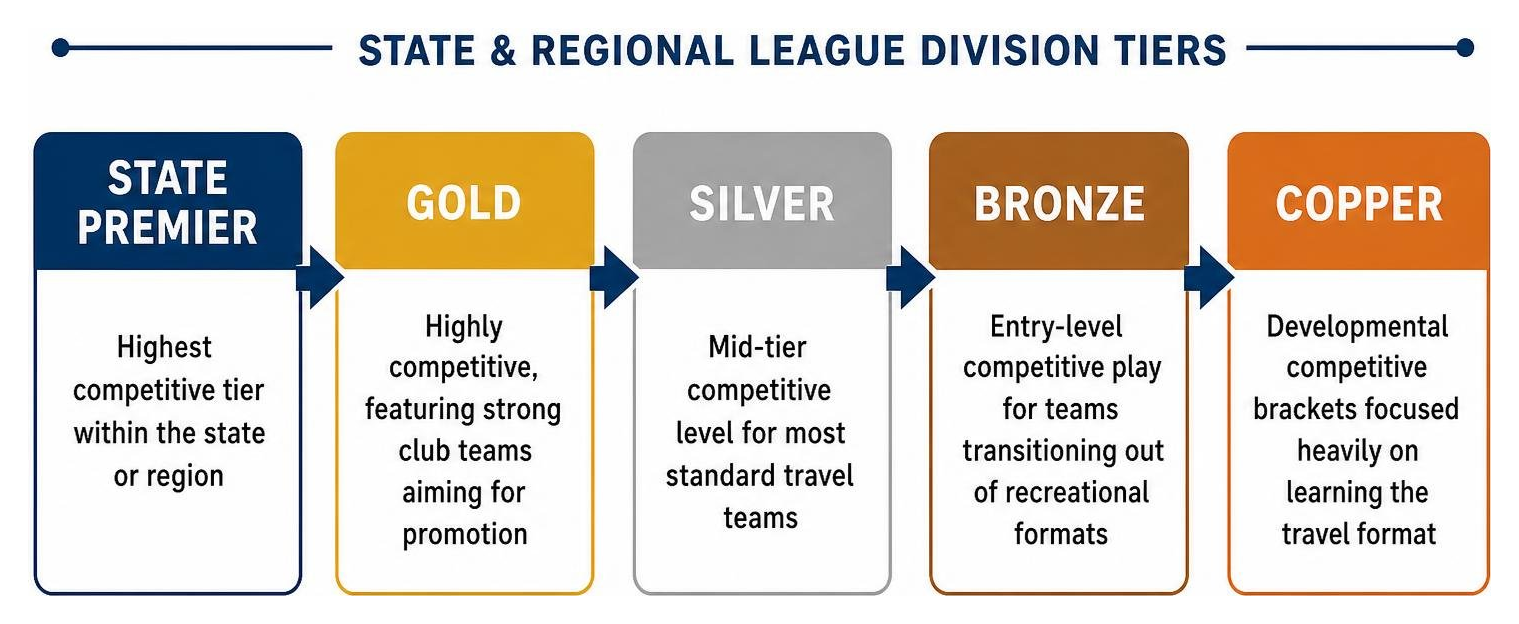
- State Premier: The highest competitive tier within the state or region, reserved for elite teams.
- Gold: Highly competitive, featuring strong club teams aiming for promotion.
- Silver: The mid-tier competitive level where most standard travel teams find their footing.
- Bronze: Entry-level competitive play for teams transitioning out of recreational formats.
- Copper: Developmental competitive brackets focused heavily on learning the travel format.
These divisions utilize a promotion and relegation process at the end of each season. This system ensures that teams are constantly challenged at their appropriate skill level. However, because these leagues are regional, travel can vary wildly. A team in a "State Premier" division might travel three hours for a single weekend game, whereas a "Copper" division team will likely play all their games within a 30-minute radius.
The Elite National Platforms: ECNL, MLS NEXT, and Girls Academy
At the absolute peak of the U.S. youth soccer pyramid sit the elite national platforms. These leagues are designed for the top 1% to 5% of players in the country. They require a massive commitment of time, energy, and money.
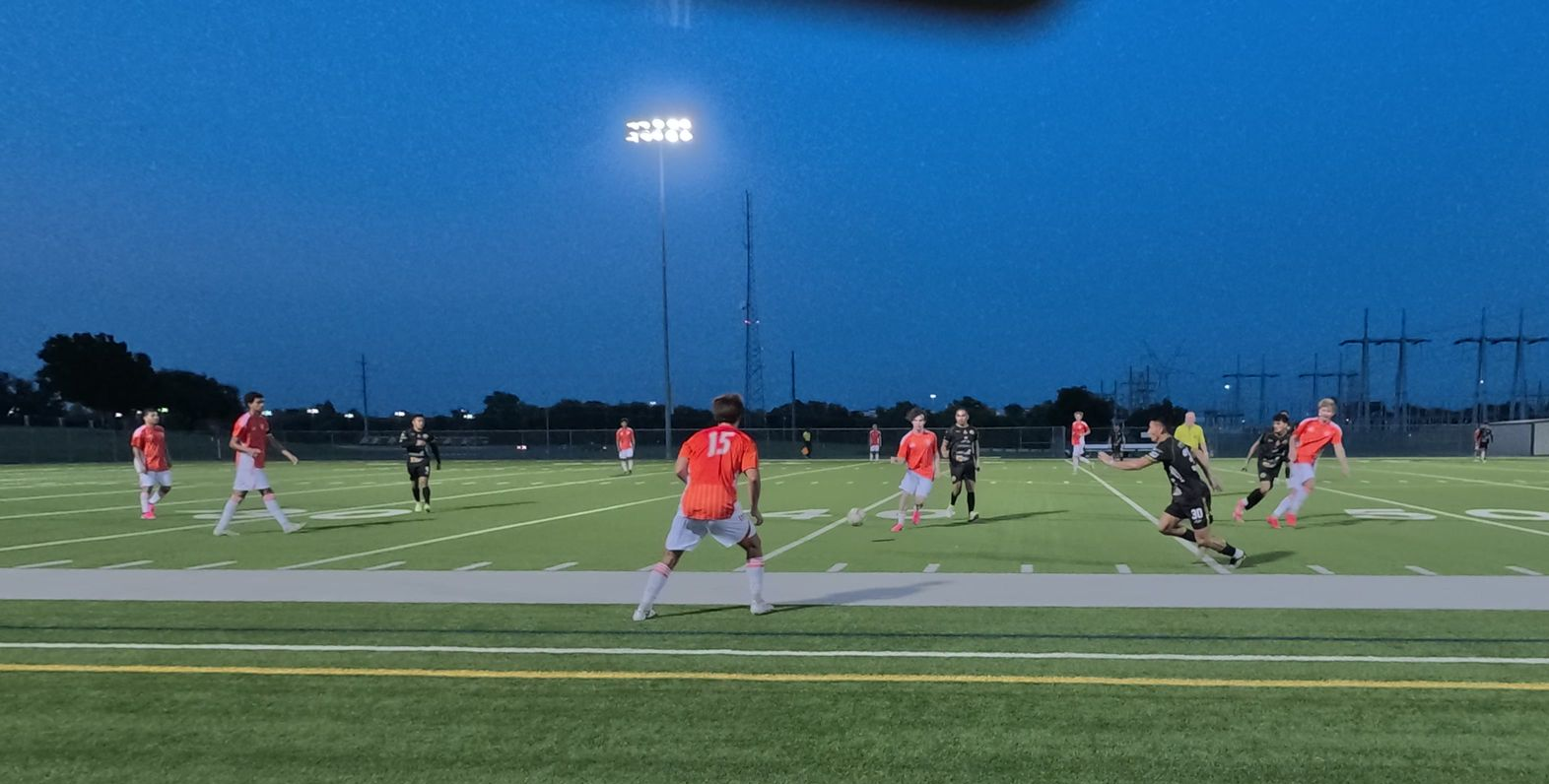
According to the comprehensive breakdown of national leagues in the Youth Soccer Levels Explained: ECNL, MLS NEXT, NPL | PitchRank guide, these platforms are designed to bring the country’s best players together to maximize exposure to college scouts and national team coaches.
However, at this elite level, clubs often face a philosophical crossroads: do they prioritize winning at all costs to maintain their league status, or do they focus on individual player growth? We explore this delicate balance in our guide, Results vs Performance: The False Choice in Youth Soccer. At Dutch FC, we firmly believe that true player development comes from focusing on performance and technical mastery rather than chasing short-term scoreboard results.
Boys Elite Pathways: MLS NEXT and ECNL Boys
For competitive boys, the elite pathway is dominated by two primary leagues:
- MLS NEXT: Created by Major League Soccer in 2020 after the sudden folding of the U.S. Soccer Development Academy, MLS NEXT is widely considered the highest tier of boys' youth soccer in the country. It includes both professional MLS club academies (which are fully funded and cost $0 for players) and elite independent youth clubs. MLS academies hold strict "Homegrown Territory" rights, allowing them to claim and develop local talent for direct pathways into professional contracts or MLS NEXT Pro teams.
- ECNL Boys: The Elite Clubs National League for boys is the premier national alternative to MLS NEXT. It features incredibly high-level competition, highly scouted showcase events, and slightly more flexibility for players who still want to participate in high school sports (which MLS NEXT generally prohibits).
Girls Elite Pathways: ECNL Girls and Girls Academy (GA)
On the girls' side of the sport, the landscape is shaped by two powerful national platforms:
- ECNL Girls: Established in 2009, ECNL Girls is undisputedly the gold standard for female youth soccer in the United States. It is the primary recruiting ground for NCAA Division I college coaches. Nearly every top college program in the country fills the majority of its roster directly from ECNL showcases.
- Girls Academy (GA): Launched in 2020 by former Development Academy clubs, the GA is a highly competitive, player-led national platform that serves as the primary rival to ECNL. It features a unique player advisory panel and offers a fantastic pathway to collegiate and national team exposure.
- Development Player League (DPL) & ASPIRE: These leagues act as the direct developmental tiers immediately below the Girls Academy, providing regional travel and national showcase exposure for players working their way up to the elite level.
The Financial Reality: What Does Each Level Actually Cost?
There is no getting around it: competitive youth soccer in the United States is expensive. The "pay-to-play" model dominates the landscape, and parents must be prepared for the financial realities of moving up the pyramid.

When evaluating clubs, it is important to understand how teams are structured and how resources are allocated. For a look at how we manage player pools and roster sizes to maximize value, read about The Squad System.
Cost Breakdown by Tier
To help you plan, here is a realistic breakdown of the annual expenses you can expect at each level of play, including the hidden costs that clubs don't always list on their tryout flyers:
- Recreational ($100 - $500/year): Includes basic registration and a simple uniform jersey. There are no travel costs, professional coaching fees, or tournament entry fees.
- Local Travel / Select ($1,000 - $2,500/year): Club fees cover professional coaching and league registration. Additional expenses include the uniform kit ($200-$400) and local travel gas.
- Regional Development (NPL/EDP) ($2,500 - $4,500/year): Club fees increase to cover higher league fees and referee costs. Families must also factor in tournament entry fees, travel lodging for 3-4 out-of-town weekends, and potential private training.
- Elite National (ECNL/MLS NEXT) ($8,000 - $15,000+/year total): While club registration fees alone range from $4,000 to $8,000, the true cost is much higher. Teams play 25-40+ games per year and travel to multiple national showcases. Flights, hotels, meals, and coach travel expenses are paid directly by the families, easily pushing the annual total into five figures.
The Major 2026/2027 Age Group Shift: Reverting to the School-Year Cycle
The youth soccer landscape is currently experiencing its biggest regulatory shakeup in a decade. Beginning on August 1, 2026, for the 2026/2027 seasonal year, US Youth Soccer, US Club Soccer, and AYSO are officially moving back to a school-year registration cycle (August 1 to July 31).
This decision reverses the calendar-year mandate (January 1 to December 31) that was introduced in 2017. For a deep dive into the official rules and regional implementations of this massive transition, you can consult the official 2026/2027 Age Grouping Rationale and the 2026/2027 Updated Decision on Age Group Formation.
How the 2026/2027 Age Group Changes Impact Youth Soccer Levels Explained
This shift back to the school-year cycle has immediate, practical impacts on every level of competitive play:
- Eliminating "Trapped Players": Under the calendar-year system, players born in the fall were often separated from their school classmates. High school seniors born in the late months of the year frequently found themselves "trapped" without a youth team to play on during their final spring season. The new school-year alignment ensures kids play with their actual grade-level peers.
- Boosting Social Development and Team Chemistry: Soccer is a social sport. Aligning team rosters with school grades allows kids to play alongside classmates, dramatically improving team chemistry, social development, and overall player retention.
- The ODP Calendar-Year Exception: In a surprising twist, the Olympic Development Program (ODP) has decided not to adopt this change. ODP will continue to utilize the calendar-year (January 1 to December 31) system. This means elite players participating in both club soccer and ODP will have to navigate a dual-system split, playing in different age brackets depending on the event.
College Soccer Recruiting: Does Your League Level Determine Your Future?
Many parents push their children toward expensive national-platform leagues because they believe it is the only way to secure a college soccer scholarship. But what is the actual recruiting reality?
First, let's look at the numbers. The jump from high school to college soccer is incredibly steep. Only about 6.1% of high school boys and 7.9% of high school girls go on to play NCAA soccer at any level. Furthermore, only a tiny fraction — 1.4% of boys and 2.7% of girls — make it onto NCAA Division I rosters.
At Dutch FC, we regularly publish college pathway advice and developmental breakdowns in our Articles & Insights section to help parents keep these numbers in perspective.
Navigating College Exposure and Youth Soccer Levels Explained
While playing in ECNL or Girls Academy provides immediate, passive visibility because college coaches flock to their showcase events, it is far from the only pathway.
If your family cannot afford the $10,000+ annual price tag of elite national leagues, your child can absolutely still play college soccer. NCAA Division III programs, for example, are prohibited from offering athletic scholarships but offer fantastic academic aid packages. Coaches at the DII, DIII, and NAIA levels actively recruit from regional NPL leagues, state premier divisions, and local high school matches.
To succeed outside of the elite national platforms, players must be proactive:
- Create a high-quality highlight video: A 3-to-5-minute video showcasing technical skills and game awareness is the single most valuable tool for reaching college coaches.
- Initiate direct email outreach: Don't wait for coaches to find you. Write personalized emails to college coaches expressing genuine interest in their academic and athletic programs.
- Attend targeted college ID camps: Choose 2 or 3 colleges where you fit academically and athletically, and attend their specific on-campus summer camps.
- Prioritize academic eligibility: A high GPA and strong test scores open up more roster spots and academic scholarship money than soccer talent alone ever could.
Frequently Asked Questions about Youth Soccer Levels
Is ECNL or MLS NEXT considered a higher level of play?
For boys, MLS NEXT is generally considered the highest competitive tier in the country because it includes the fully funded professional MLS academies. ECNL Boys sits directly alongside it as the premier independent club platform. For girls, ECNL is undisputedly the top national tier, with the Girls Academy (GA) operating as a highly competitive, parallel elite platform.
What is the difference between USYS and US Club Soccer?
USYS (US Youth Soccer) is the traditional, state-association-based governing body that administers local travel leagues and the National Championship series. US Club Soccer is an independent, club-centric organization that governs national-platform leagues like ECNL and regional platforms like the National Premier Leagues (NPL).
How can I find out what level my child is currently playing at?
You can easily audit your child's level by checking their league schedule. Look at the official standings page for their division. If they are playing in local travel leagues against neighboring towns, they are in a state-level competitive division. If they are traveling across state lines for multi-game weekend showcases, they are playing in a regional or national-platform tier.
Conclusion
Navigating the complex world of youth soccer levels can feel like learning a completely new language. But at the end of the day, the "best" level for your child is not the one with the most prestigious acronym or the highest price tag. The best level is the one where your child is actively developing, receiving quality coaching, getting meaningful playing time, and, most importantly, falling in love with the game.
At Dutch Football Club in Frisco, Texas, we reject the high-pressure, high-cost model that dominates youth sports. Our philosophy is built entirely on the legendary Dutch "Total Football" system — focusing on technical mastery, creative decision-making, and structural versatility.
We are proud to offer a low-cost, high-value development model that provides professional, elite-level training without forcing families to break the bank. From our skills academies and select teams to our pre-professional UPSL 1st Team, we provide a complete, clear pathway for players of all ages and ambitions.
To learn more about who we are and what we stand for, we invite you to explore Our Culture Values and browse our parent Resources.
Ready to experience a smarter, player-first approach to youth soccer? Join a Dutch FC Team today and take the first step on your child's developmental journey.