
Why Youth Soccer Playing Time Decides Whether Your Child Stays in the Game
Youth soccer playing time is one of the most debated — and most misunderstood — topics in youth sports today. Here is what every parent and coach needs to know at a glance:
Quick answers:
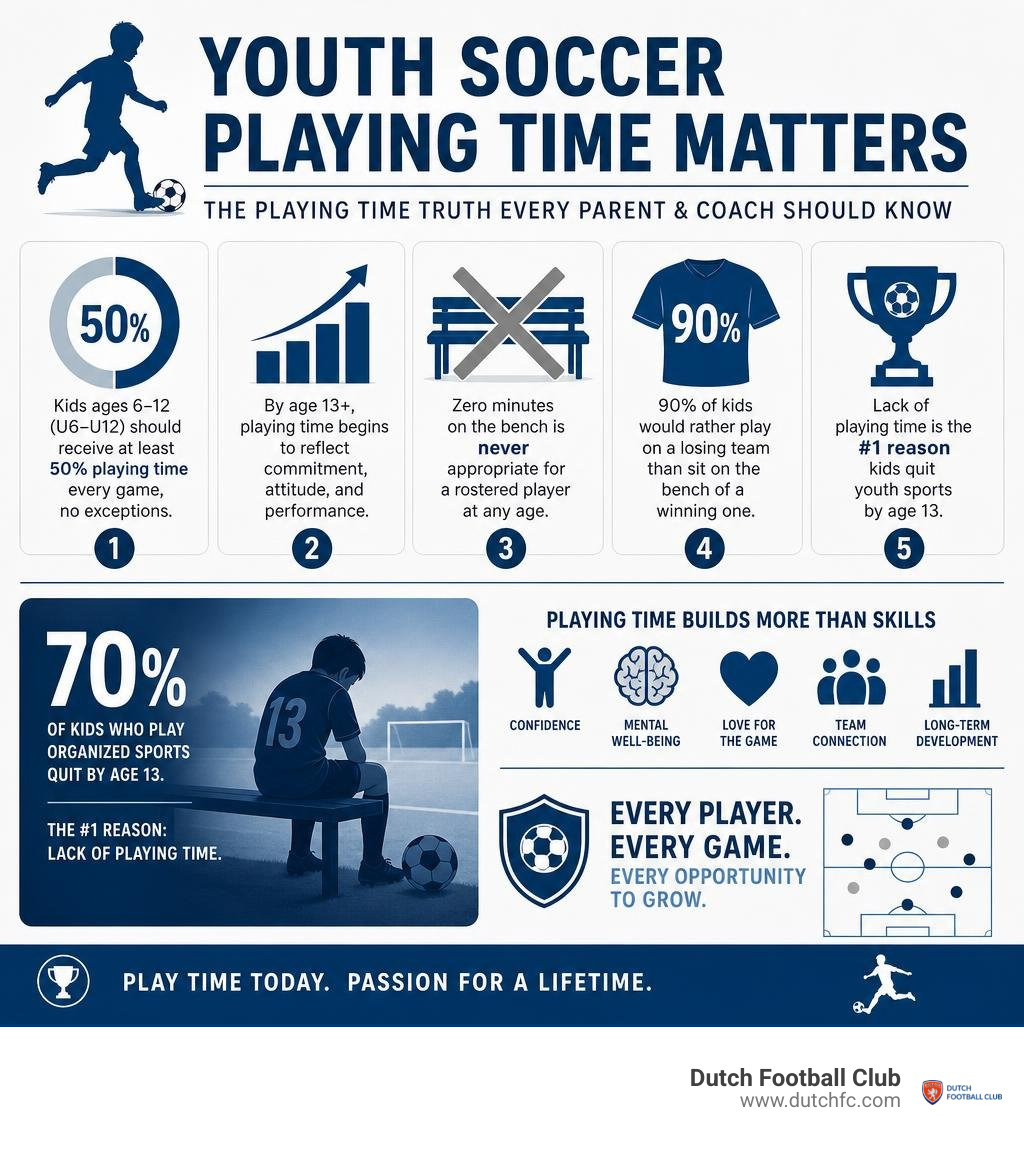
- Kids ages 6-12 (U6-U12) should receive at least 50% playing time every game, no exceptions
- By age 13+, playing time begins to reflect commitment, attitude, and performance
- Zero minutes on the bench is never appropriate for a rostered player at any age
- 90% of kids would rather play on a losing team than sit on the bench of a winning one
- Lack of playing time is the #1 reason kids quit youth sports by age 13
The numbers are hard to ignore. Around 70% of kids who play organized sports quit by age 13, and the leading cause is not too much homework or busy schedules — it is sitting on the bench. A child who travels to a game, puts on their uniform, and never steps on the field does not just have a bad Saturday. Research suggests that being excluded from play activates the same regions of the brain as physical pain. The damage runs deep.
And yet, benching young players — sometimes for entire games or entire tournaments — remains common practice across youth soccer programs in the United States.
There is a better way.
I'm Wilco Ravestijn, spokesperson for Dutch Football Club in Frisco, Texas, where our Total Football development model is built around the belief that every player deserves meaningful youth soccer playing time to grow, build confidence, and fall in love with the game. In over 25 years of experience in youth development, I have seen how the right approach to playing time can make or break a young athlete's entire relationship with soccer.
The Psychological and Developmental Cost of Zero Minutes
When a young player is forced to watch an entire match from the sidelines, the message they receive is loud and clear: You are not good enough, you do not belong, and your presence here does not matter.
This psychological trauma is far-reaching. It is easy for adults to dismiss benching as a natural part of competitive sports, but for a child, it is a deeply isolating experience. When we look at discussions on platforms like Playing Time | Your Soccer Forum, we see parent after parent describing the social isolation and embarrassment their children face. Benched players often feel alienated from their teammates and may begin to withdraw socially. They hide behind the dugout or sit quietly on the sidelines, feeling like outsiders in their own team.
Furthermore, kids do not develop their skills by watching others play. Active game repetitions are critical for developing spatial awareness, quick decision-making, and technical execution under pressure. According to the foundational principles discussed in Why Equal Playing Time Matters More Than Winning (U5–U12), a youth player touches the ball between 40 and 60 times in a standard match. Over a 20-match season, the difference between playing half a game and sitting on the bench is the difference between 1,000 active touches and zero. You simply cannot build confidence or competence without those touches.
How Unequal Youth Soccer Playing Time Triggers the 70% Dropout Rate
Data from the Aspen Institute’s Project Play reveals a startling trend: 75% of youth athletes quit organized sports by the age of 13. When kids are asked why they walk away, the answer is rarely about losing games. In fact, a landmark George Washington University study found that out of 81 reasons kids play sports, "having fun" was ranked number one. "Winning" was ranked all the way down at number 48.
Getting playing time is one of the top definitions of having fun. The Josephson Institute found that 90% of children would rather play on a losing team than sit on the bench of a winning team. When coaches prioritize short-term victories by keeping their "best" players on the pitch for the entire game, they are actively driving the other players out of the sport. This early retirement is a systemic failure of youth player development.
The Biological Reality of Late Bloomers and the Relative Age Effect
One of the most dangerous mistakes a youth coach can make is confusing temporary physical maturity with long-term athletic talent. This phenomenon is known as the Relative Age Effect (RAE). Children born early in the selection year (e.g., January through March) are often physically, cognitively, and emotionally more advanced than their peers born later in the year.
During puberty, players experience Peak Height Velocity (PHV), a rapid growth spurt that can temporarily cause coordination awkwardness. An early-maturing player might be taller, stronger, and faster at age 12, prompting a coach to give them maximum youth soccer playing time. Meanwhile, a highly technical but smaller, late-maturing player is left on the bench.
According to scientific research on maturation and fitness in youth soccer, physical traits like aerobic capacity (VO2max) and biological maturation strongly influence coach decisions regarding minutes played. However, the study also highlights that late bloomers who are given the time to catch up physically often develop superior technical skills and tactical intelligence because they could not rely on raw physical size to win matchups early on. If we bench them now, we lose them before they ever have a chance to shine.
Balancing Winning vs. Development in Youth Soccer Playing Time
Every youth soccer coach faces a choice: are we coaching to win today's match, or are we coaching to develop players for the next ten years?
At Dutch Football Club, we believe that prioritizing short-term results over long-term player development is a false choice. When you focus on performance, learning, and systemic growth, the results naturally follow. We explore this dynamic in detail in our guide, Results vs Performance The False Choice in Youth Soccer.
Recreational vs. Competitive Club Soccer Standards
The standards for managing youth soccer playing time must shift as players mature, but the transition should be gradual and logical.
- U10 and Younger (Developmental Era): At this stage, whether playing in an academy or a recreational league, every single player should receive a minimum of 50% playing time. The focus must be entirely on mastery, experimentation, and joy.
- U11 and U12 (Transitional Era): Players should still expect to receive roughly 40% to 50% of game time. This is where we begin to introduce competitive standards while ensuring no player is left behind.
- U13 and Older (Competitive Era): Playing time becomes earned based on attendance, attitude, and performance. However, zero-minute games should still be avoided for healthy, rostered players.
To understand how these environments differ structurally, you can read A Comparison Guide of Club School and Recreational Soccer Programs.
The Role of Club Philosophy in Distributing Minutes
A club's true values are not written on its website; they are demonstrated on the sidelines on Saturday mornings. If a club claims to value development but allows coaches to park developmental players on the bench to secure a trophy, their philosophy is compromised.
Providing consistent playing time builds overall squad depth. If your star players get injured or miss a match, a well-developed bench can step in seamlessly because they have active game minutes under their belts. This approach protects team morale and keeps families engaged. You can learn more about how we implement these standards by reading our Club Philosophy and exploring Our Culture Values.
The 6 Core Factors That Determine Playing Time
While we advocate for fair playing time, competitive club soccer (U11+) is not a simple democracy. Minutes on the pitch are influenced by six core factors that every player and parent should understand:

- Attendance and Commitment: Players are expected to maintain at least 75%-80% attendance at training sessions and 90% at games to keep pace with tactical developments.
- Attitude and Work Ethic: A positive attitude, a willingness to coachability, and high effort during drills are non-negotiable standards.
- Talent and Ability: Technical proficiency and physical fitness naturally influence a coach's tactical options.
- Game-Day Performance: How well a player executes the game plan and handles pressure during matches.
- Playing Position: Positional depth and the specific tactical needs of a game (e.g., needing an extra defender to preserve a lead).
- Game Significance: While all games matter, high-stakes matches like cup finals or showcases may require tighter rotations.
Categorizing Players: Impact, Role, and Developmental Tiers
To remove subjectivity and foster player accountability, coaches often evaluate players using concrete statistical benchmarks, such as turnover rates and 50/50 challenges won. This data-driven approach is detailed in our resource on Playing Time in Club Soccer.
| Player Category | Average Playing Time | Statistical Benchmarks | Coaching Approach |
|---|---|---|---|
| Impact Player | 75% - 100% of match | Turnovers < 40%, 50/50 challenges won > 60% | Key drivers of tactical execution; must maintain high work ethic to keep spot. |
| Role Player | ~50% of match | Turnovers ~50%, 50/50 challenges won ~50% | Reliable contributors; focus on turning role players into impact players. |
| Developmental Player | Earning time in practice | Turnovers > 60%, 50/50 challenges won < 40% | Focus on skill development in low-pressure situations; transition to lower-tier teams if game time falls below 30%. |
A player's daily actions, commitment, and attitude determine their category. If a developmental player is consistently playing less than 50% of a game, we often recommend transitioning them to a team where they can be an impact player, rebuild their confidence, and get the touches they need to grow.
Why Defenders and Goalkeepers Experience Different Substitution Patterns
It is a common observation on youth sidelines: defenders and goalkeepers are subbed out far less frequently than forwards and midfielders. This is not favoritism; it is tactical reality.
Defenders act as the "lock" of the team. Because defensive chemistry, positioning, and communication with the goalkeeper are highly sensitive, coaches avoid disrupting this unit mid-game. Furthermore, central defenders and goalkeepers cover less high-intensity sprinting distance than wingers and forwards, meaning they can sustain their performance levels for longer periods without needing rest.
Practical Strategies and Tools for Fair Player Rotation
Coaching a youth soccer team is hard work. You have to manage tactics, monitor player safety, keep track of the opponent, and somehow calculate fair substitutions in your head.

Fortunately, you do not have to be a human spreadsheet. By using structured rotation strategies and digital tools, you can ensure fair play while keeping parent conflicts to a minimum. To learn more about modern tracking methods, check out How to Track Fair Playing Time in Youth Soccer.
Mathematical Formulas for Equal Youth Soccer Playing Time
Calculating fair playing time is a matter of basic arithmetic. To find the target minutes for each player, use this simple formula:
$$\text{Target Minutes Per Player} = \frac{\text{Game Length} \times \text{Players on Field}}{\text{Total Roster Size}}$$
For example, if you are coaching a U10 team playing a 7v7 format (50-minute game) with a roster of 9 players:
$$\text{Target Minutes} = \frac{50 \times 7}{9} = 38.8 \text{ minutes per player}$$
To manage this smoothly, coaches can utilize digital tools like the Soccer Playtime Calculator: Split Minutes Evenly | Game Time Coach or the Equal Playing Time Calculator & Guide for Youth Soccer Coaches | MatchdayIQ.
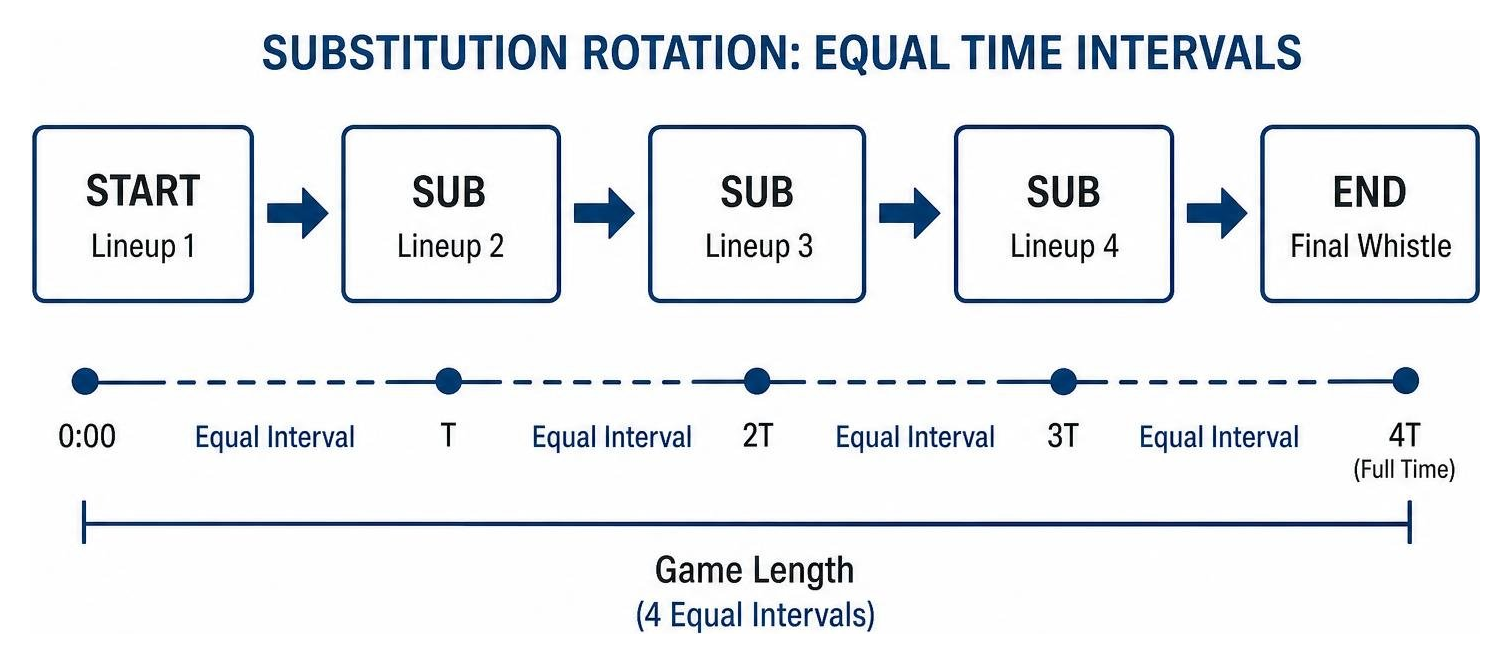
Instead of subbing randomly, break your match into equal substitution intervals.
Managing Tournaments, Showcases, and Travel Events
Tournaments and travel events present a unique challenge. Families invest significant time, money, and energy to travel to out-of-town games, and expectations are understandably high.
Coaches must establish clear guidelines before the tournament begins. In high-level showcases where college scouts are present, playing time will naturally favor players who are ready for that level of exposure. However, it is fundamentally unfair to ask a family to travel six hours only to give a player zero minutes.
To prevent post-game blowups, we strongly enforce the 24-hour rule: parents must wait 24 hours after a game ends before contacting a coach to discuss playing time. This allows emotions to cool and ensures a constructive, development-focused conversation.
Frequently Asked Questions about Youth Soccer Playing Time
At what age should equal playing time transition to merit-based playing time?
The transition generally begins around age 11 or 12 (U11-U12). Under the age of 10, development and equal participation must take priority. By age 13 (U13+), especially in highly competitive select/academy leagues, playing time is earned based on performance, attendance, and attitude. However, even at competitive levels, rostered players should receive meaningful minutes to support their ongoing growth.
How should coaches handle playing time for developmental players who attend every practice?
Commitment should always be rewarded. If a player is less skilled but maintains excellent practice attendance and a great attitude, coaches should actively look for opportunities to play them. This can be achieved by placing them in lower-pressure positions on the field, pairing them with stronger teammates who can guide them, or utilizing comfortable leads to give them valuable game repetitions.
What is the best way for parents to discuss playing time with a coach?
Parents should encourage their child to initiate a player-led conversation first. This teaches the young athlete accountability and self-advocacy. If a parent meeting is necessary, it must take place at least 24 hours after a match. The conversation should focus on constructive feedback — asking "What does my child need to improve in practice to earn more minutes?" rather than comparing their child to other players on the roster.
Conclusion
At Dutch Football Club in Frisco, Texas, we believe that youth soccer should be a launchpad for character, health, and a lifelong love of the game. Our Dutch "Total Football" philosophy is designed to develop versatile, creative, and confident players who understand that their worth is not defined by a scoreboard or a bench.
We are committed to providing a high-value, development-first model where every player is given the tools, the coaching, and the active playing time they need to reach their full potential. To learn more about how we prepare young athletes for the pitch and for life, read about our Game Plan for Life and explore our approach to Playing Time in Club Soccer.
If you are looking for a soccer experience that values your child's long-term development over short-term trophies, we invite you to connect with us.